The Petite Guide to Summer Dresses That Don't Swallow You
Quick Answer: Under 5’4”, summer dresses go wrong through unstructured volume. Choose a defined or empire waist, a length that ends at the slimmest part of your shin rather than mid-calf, and smaller-scale prints and straps. Above-knee lengths show the most leg and add the most visual height. Tailor a maxi to true ankle length instead of cuffing it.
Summer dresses promise breezy ease. Then the maxi pools around your ankles, the oversized trend swallows you whole, and the midi cuts you off at the widest point of your calf.
None of that is a body problem. It’s a proportion problem, and proportion is fixable with about four decisions.

Why Do Summer Dresses Overwhelm Petite Frames?
Because volume without structure erases proportion.
A flowing dress with no defined waist doesn’t skim a petite frame — it covers it. The fabric becomes the shape, and where your waist actually sits becomes invisible. From a few feet away, the outfit reads as a column of fabric with a head on top.
Standard sizing compounds it. Most non-petite dresses are cut for a 5’6” to 5’8” frame, which means the waist seam lands low, the armholes sit deep, and every length runs long. Each of those errors is small; stacked together they’re the whole problem.
The fix isn’t avoiding flowy dresses. It’s making sure something in the outfit defines where you actually are inside it.
Which Lengths Actually Work?
Length is the biggest single lever, and there are three that work.
Above-knee and mini — the most leg on show, which is the most reliable way to add visual height. A mini on a petite frame is proportionally the same as a mid-thigh dress on someone taller.
Midi, but precisely placed. This is where most petite dresses fail. A midi has to end at the slimmest point of your shin — usually just below the widest part of the calf, a few inches above the ankle. Mid-calf is the single most shortening length there is, because it cuts the leg at its widest point.
Maxi, slim-cut and truly ankle-length. It works when the hem clears the floor by about half an inch and the cut is narrow. A voluminous maxi that pools is the classic drowning silhouette.
The crucial part: tailor, don’t cuff. Hemming a dress costs $15 to $25 and takes a week. Rolling or cuffing adds bulk exactly where you’re trying to create a clean line.
What Should You Look for in Waists and Necklines?
Defined or empire waists lift the proportion by raising the visual midpoint. Empire cuts sit just under the bust and give the longest possible lower half. A defined natural waist works too, as long as the seam actually lands at your waist and not two inches below it.
Waistless shifts need a belt. Left alone they advertise fabric. Add a thin belt at your natural waist and the same dress works immediately.
V-necks and open collars elongate. An open neckline extends the visual line of the neck and torso upward, which is the vertical equivalent of everything you’re doing with the hem.
High necks and heavy collars do the opposite — they shorten the upper body and add width across the shoulders. Not banned, just harder.

How Should Prints and Details Be Scaled?
To your frame, not to the trend.
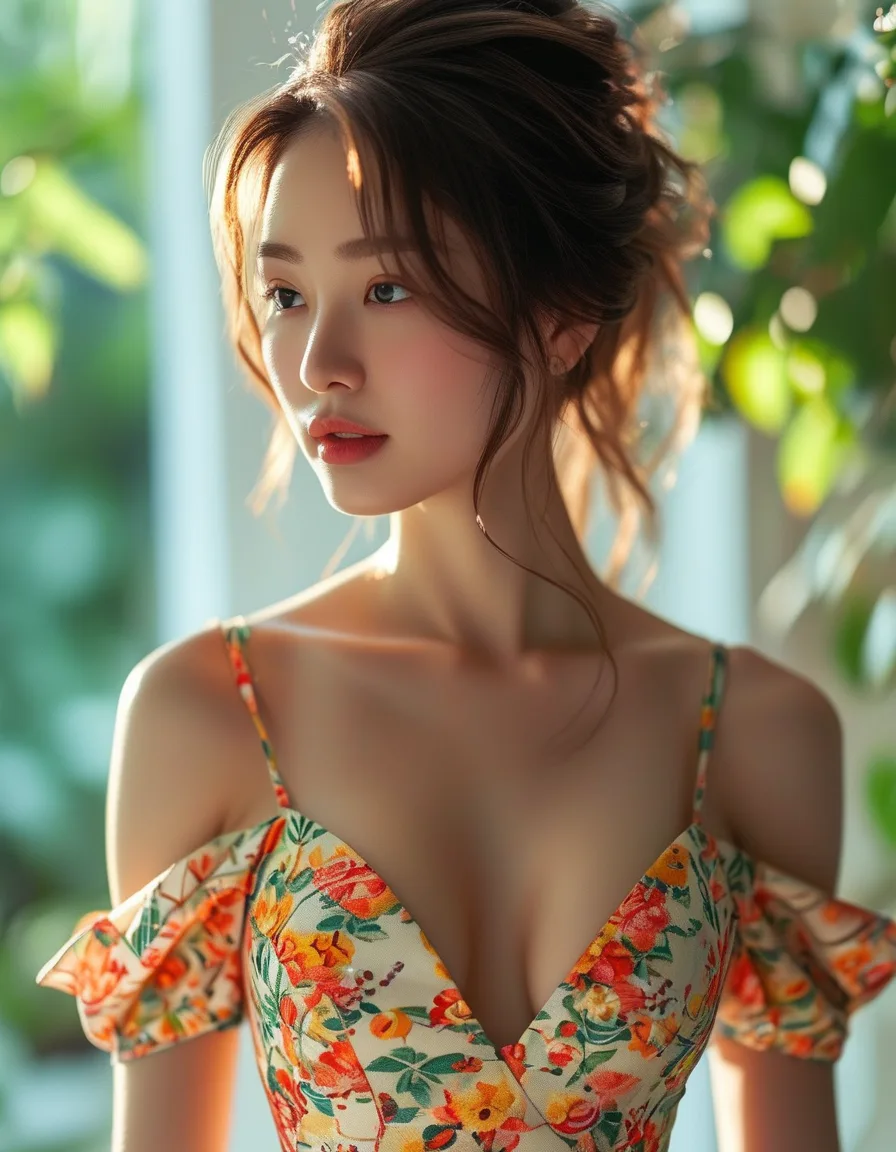
- Smaller prints — a ditsy floral reads correctly on a petite frame; a huge tropical print reads as one enormous pattern with a person inside it
- Narrower straps — wide straps eat shoulder width and shorten the upper body
- Scaled-down ruffles — a small tiered detail is charming, a dramatic flounce takes over
- Modest sleeve volume — a slight puff works; a full balloon sleeve competes for space
The principle behind all of it: details should whisper your size rather than shout the dress’s. Proportion applies to pattern and trim exactly as it does to hemlines.
Vertical elements help: button plackets, seaming lines, and narrow vertical stripes all extend the line rather than interrupting it.
What Nobody Tells You About Petite Dressing
Nude sandals add more visual height than heels do. A shoe close to your skin tone continues the leg line to the floor. It’s a bigger effect than two inches of heel, and considerably more comfortable in August.
The front tuck is free tailoring. On a shirt dress or anything with volume, tucking just the front hem at the waist defines the midpoint instantly and costs nothing.
Monochrome is the strongest lengthening tool available. A single color from shoulder to shoe removes every horizontal break. Combine it with nude sandals and the effect is genuinely noticeable in photos.
Hair up adds real inches to the impression. A high ponytail or a topknot extends the vertical line at the top exactly the way nude shoes do at the bottom.
And petite-specific sizing is worth trying, not just smaller sizes. Petite ranges shorten the sleeve, raise the waist seam, and adjust the armhole — a smaller regular size fixes width but leaves every proportion in the wrong place.
Mini FAQ
What dress length is most flattering for petite women?
Above-knee lengths add the most visual height. If you want longer, a midi should end at the slimmest part of your shin, and a maxi should be slim-cut and hemmed to just clear the floor.
Can petite women wear maxi dresses?
Yes, with two conditions: a slim rather than voluminous cut, and a true ankle-length hem. Get it tailored rather than cuffed, since cuffing adds bulk at exactly the wrong point.
Do petite women have to avoid large prints?
Not entirely, but scale matters. A large print works better on a fitted piece than a flowing one, where it can dominate the whole silhouette. Smaller-scale prints are the safer default.
TL;DR:
- Volume without a defined waist is what makes dresses swallow petite frames.
- Above-knee is the most lengthening; midis must hit the slimmest part of the shin, not mid-calf.
- Tailor maxis to true ankle length — never cuff.
- Choose empire or defined waists, V-necks, narrower straps, and smaller-scale prints.
- Nude sandals, a front tuck, monochrome, and hair up all add visual inches for free.
Choose dresses that respect your proportions and summer’s breeziest garment becomes your most flattering one.
Keep Reading
This article is for general styling and informational purposes only. Trends, sizing, availability and pricing may vary by brand and season.